
Embrace THE next evolution of music performance.
We are
revolutionizING
how music is
recreated and
experienced.
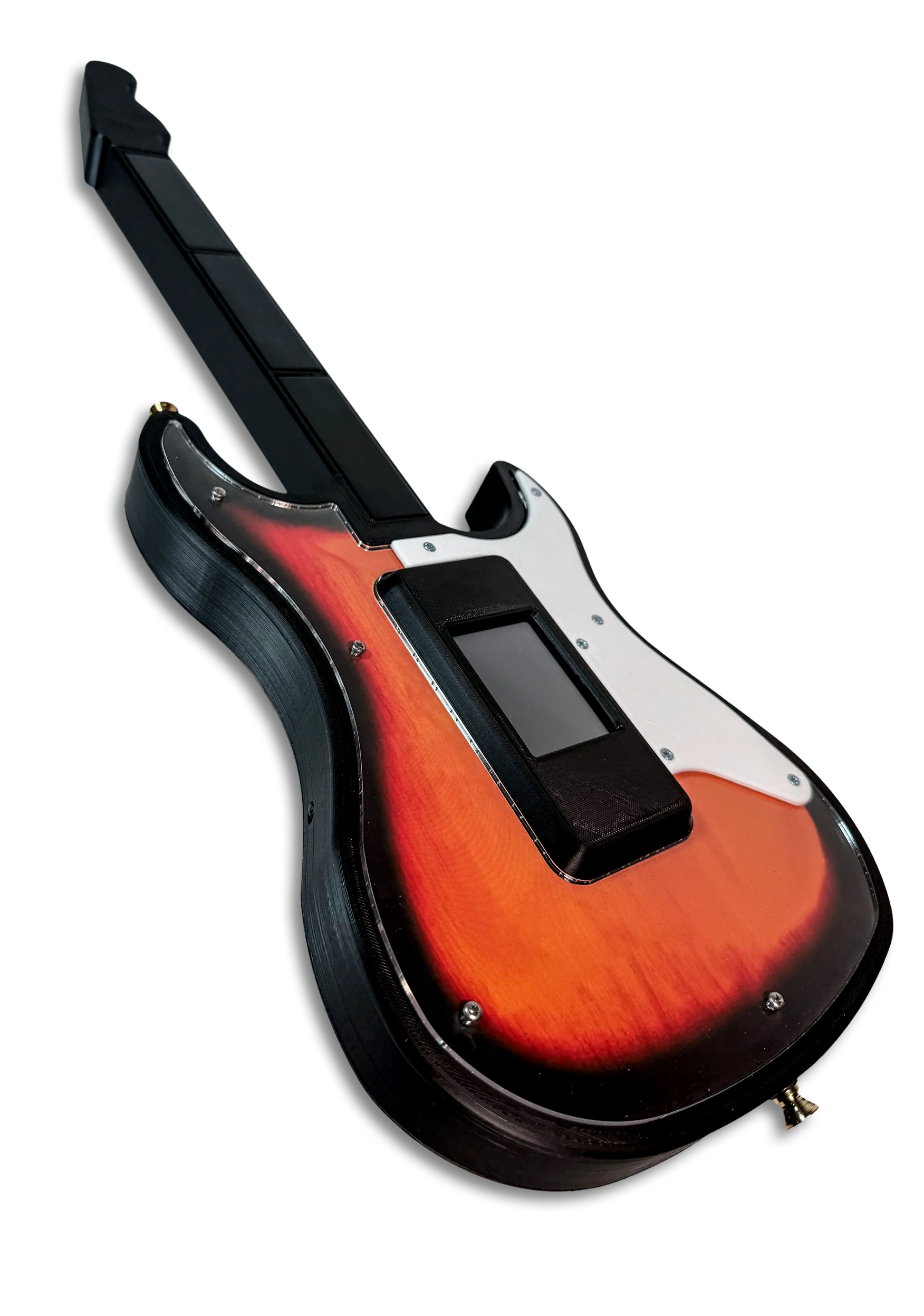
Dream Guitar is a touchscreen controller modeled after a standard guitar, with a 14 control point neck and strum field that lets anyone play like their favorite legendary guitarist. Merging instrument, game, and live performance into one platform.
The Lucid Dream Guitar is intuitive to anyone who has used a game controller or tablet and eliminates the traditional learning barrier for guitar.
Turn music performance into an interactive, immersive experience.
LUCID DREAM GUITAR
See it in action!
Sign Up
Sign up to be the first to know about the Lucid Dream Guitar.

Don’t just listen to music, experience it.
Now you can play all your favorite songs exactly like the original artist, with no musical skills required. From the vibrations of your instrument to the sound you create, with this guitar you inhabit the music of your icons. Jam solo, socially, or virtually with a band.
how it works
Simply upload the audioDNA packets of your favorite artist or song from our global Dream Packet Store for playable song experiences. The Lucid Dream Guitar will guide you through playing the song as it originally sounded. Notes, strumming, hammer-ons and pull-offs, you’ll be in control of it all.
Once you’ve mastered replaying your favorites you can even mix it up and create your own music from the sounds of old favorites.

*Product design subject to change
dream. upload. play.

Frequently Asked Questions
-
Lucid Dream Guitar is an interactive digital instrument that lets users play downloadable song packets using proprietary AudioDNA sound-particle technology.
-
It does not use strings.
It uses touch interaction and a strum field to trigger reconstructed guitar sounds.
It is designed for fast playability and reduced learning curve. -
No. Lucid Dream Guitar is a playable instrument platform with downloadable song packets, learning tools, and free-play capability. It is not a fixed game with limited tracks.
-
No. It uses proprietary AudioDNA sound-particle technology, not standard MIDI tones.
-
A Dream Packet is a downloadable song experience. It contains the interactive sound-particle data that allows you to play a specific song style or guitar performance.
-
You purchase and download Dream Packets from the Packet Store. Packets are added to your library and installed into your guitar.
-
Yes. The Learning Software allows you to adjust tempo and practice slowly before increasing speed. You receive feedback if you miss timing.
-
Yes. Free-play mode allows you to trigger particles and create original music.
-
Yes. The platform is designed to support social and connected play, including jam sessions and band-style modes.
-
Immersive and band-style experiences are part of the long-term platform vision. Feature availability depends on development phase and version.
-
No. The system is designed for beginners and casual players, while still offering depth for experienced users.
-
Yes. The system is patent-pending and includes proprietary hardware and software components developed by AudioDNA.
-
The guitar is the hardware platform. Ongoing revenue comes from downloadable Dream Packets and membership options.
-
The platform is currently in prototype and development stages, with continued refinement and expansion planned.
TECHNICAL FAQ FOR BUYERS
What intellectual property protection is in place?
1
Patent-pending system covering hardware and software.
Includes sound extraction, particle creation, packet architecture, and interactive instrument playback.
Designed as a platform-level IP position, not just a device patent.
What exactly is AudioDNA technology?
2
Proprietary system that converts recorded guitar performances into interactive sound particles.
Particles are categorized and structured for real-time triggering.
Not MIDI-based.
Built to replicate guitar behaviors such as bends, slides, hammer-ons, pull-offs, and chord transitions.
Is the system dependent on original master recordings?
3
No master recordings are embedded into packets.
The system reconstructs playable sound behavior.
Licensing strategy can be layered on top of the platform for artist-branded packets.
What file architecture is used for Dream Packets?
4
Packets contain structured sound-particle data, not static audio files.
Designed for scalable distribution via packet store.
Built for low bandwidth distribution and repeat installation.
How is packet creation handled?
5
What is the scalability of the content model?
6
What is the hardware architecture?
7
Is this a closed or open ecosystem?
8
Can the platform expand beyond guitar?
9
What development stage is the product in?
10
What are estimated hardware economics?
11
Songs are processed through proprietary extraction workflow.
Particles are categorized and assigned structured identifiers
QA process validates timing and behavior consistency.
Once built, packets are infinitely replicable.
Yes
Patent coverage extends to piano, drums, banjo, and additional digital instruments.
Technology architecture is instrument-agnostic at the software level.
Functional prototype exists.
Extraction and playback workflow validated.
Packet Store model defined conceptually.
Hardware refinement and manufacturing optimization remain part of scale phase.
Prototype cost is high due to small-batch production.
Production cost expected to decrease significantly at scale.
Long-term revenue focus is digital packet margin, not hardware margin.
Hybrid of instrument, content marketplace, and interactive performance platform.
Positioned between music hardware, gaming, and digital content ecosystems.
Expandable into immersive band-style and connected performance modes.
What is the long-term strategic positioning?
12
Packets are created once and distributed infinitely.
Minimal marginal cost after creation.
Library can scale to thousands of songs.
Revenue model supports subscription and per-packet purchase.
Touch-enabled neck interface.
Strum field activation zone.
Internal processing board.
Bluetooth / wireless update capability (development stage dependent).
Designed for expansion to internal speaker and production-level refinements.
Designed as a controlled ecosystem for quality and IP protection.
Packet Store functions similarly to app-store architecture.
Expansion into other instruments uses same platform logic.